Bond Heads · Semiconductor packaging · Bond head module
Force-Sensing TCB Bond Headfor Advanced Packaging
AI processors and high-bandwidth memory stack dies with thousands of microscopic joints, formed by thermo-compression bonding. Axiom’s own force-sensing bond head and pulse heater: a linear-motor axis on a flexure guideway with a force sensor in the load path, and a ceramic-isolated heater with zoned vacuum, developed, built and integrated in-house.
Key figures
- Maximum bond force, design specification
- 60 N
- Travel stroke on the flexure guideway, design specification
- ±0.3 mm
- Resolution of the selected linear encoder
- 50 nm
- Maximum heater temperature, design specification
- 300 °C
- Repeatability of the selected 0–200 N force sensor
- ≤ ±0.1 % FS
- Independently controlled vacuum zones in the progressive release concept
- 3
DESIGN Design value
Figures are design specification values, values of the selected components and analysis results, not measurements. The servo drive the module is designed for is described under “Compact Single-Axis Servo Drive, Dual-Encoder Closed Loop”. The pulse heater and vacuum system are shown in simplified form, without internal details.
Overview
- Industry
- Semiconductor packaging
- Application
- Thermo-compression bonding of thin dies in advanced packaging
- Deliverable
- Bond head module
- Family
- Bond Heads
Thermo-compression bonding presses and heats each die in one short cycle, and the head must meet three demands at once. Force: it must find contact and build bond force without an overshoot that could crack a thin die. Heat: it must reach the joint fast while the guides, sensor and encoder above stay cool. Flatness: dies thinner than a sheet of paper warp easily on pick-up and release. The three pull against each other, since heat distorts precision mechanics and a stiff structure makes force control harsh.
Architecture & engineering
Axiom develops the bond head as its own module, across mechanics, thermal design, electrical design, control and precision machining. A linear motor on a flexure guideway was chosen over a rotary motor with ball screw on crossed-roller guides, for better controllability and lower risk of damaging the die. A force sensor in the load path measures the bond force at the tool for Axiom’s own force and position control algorithms, designed to find contact and build force without overshoot. The module was treated as one system, with decisions taken together and checked analytically and in simulation before drawings were released. A pulse heater is engineered alongside it.
Force-sensing axis
The motor drives a moving housing that runs on a flexure guideway inside the static housing. The force sensor sits between the moving housing and the bond tool, so it reads the force where it is applied. The motor, force sensor and linear encoder close force and position loops on Axiom’s own servo drive. At about 30 × 35 × 25 mm the drive is small enough to mount at the axis rather than in a cabinet, so the module stays compact and the sensor and encoder signals run short.
- Guideway
- A flexure guideway in AISI 301 sheet gives a ±0.3 mm stroke at a stiffness of 16.4 N/mm. Sized analytically and checked by CAE, it reaches 389 MPa at the 1.2 mm stopper deflection, below the material’s yield and fatigue strength, and its friction-free motion gives smooth, repeatable force at the die.
- Drive & feedback
- A compact linear rod motor, compatible with Axiom’s own servo drive, closes the position loop on a 50 nm linear encoder. Its peak force of about 45 N follows from 60 N of bond force plus 4.9 N from the flexure, less 20 N of moving weight.
- Force sensing
- A 0–200 N force sensor in the load path, with a repeatability of ≤ ±0.1 % FS, measures the bond force directly rather than estimating it from motor current, which also carries the flexure’s spring force and the moving weight. Its range leaves headroom above the 60 N process force.
- Control
- Axiom’s own force and position control algorithms run on its servo drive, described under “Compact Single-Axis Servo Drive, Dual-Encoder Closed Loop”. The design targets a bond-force accuracy of ±0.5 % FS at an assumed 500 ms cycle time; with 2 kg of moving mass, inertial force over the short stroke is negligible.
Pulse heater
The pulse heater is the thermal core of the module, at the tip of the bond head. It picks the die up by vacuum, heats it at the point of contact, up to 300 °C, and lets it cool again within one cycle, while the force sensor, encoder and flexures above it stay cool. Axiom handles the thermal, mechanical and assembly requirements together in one compact heater module, with design documentation and assembly planning so that it can be manufactured and assembled. The ceramic parts are designed for manufacturability with the ceramics supplier from the first design.
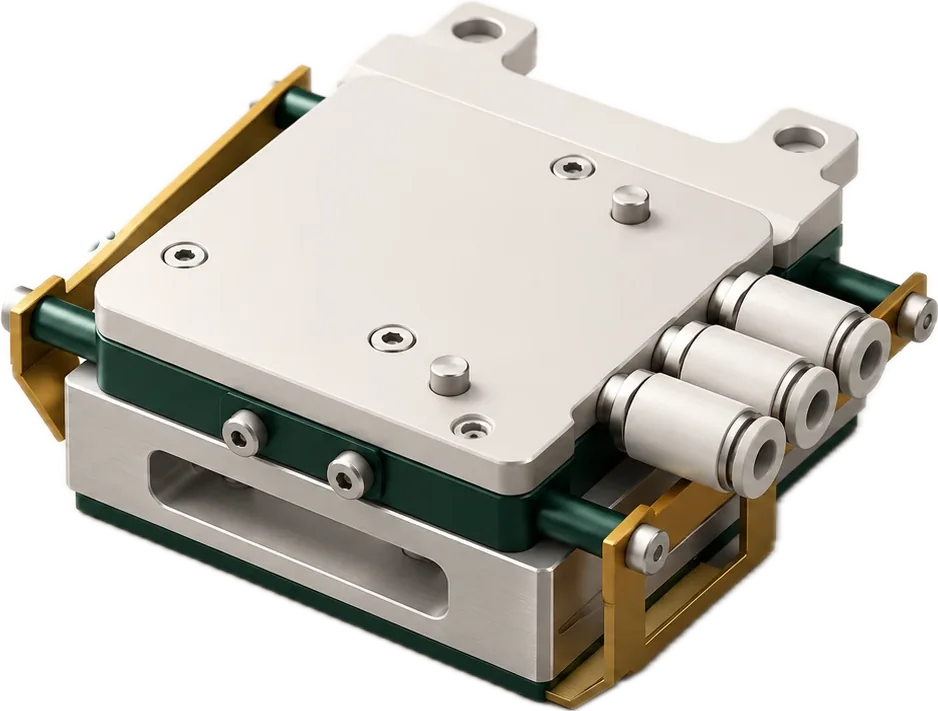
Illustrative render, internal features omitted
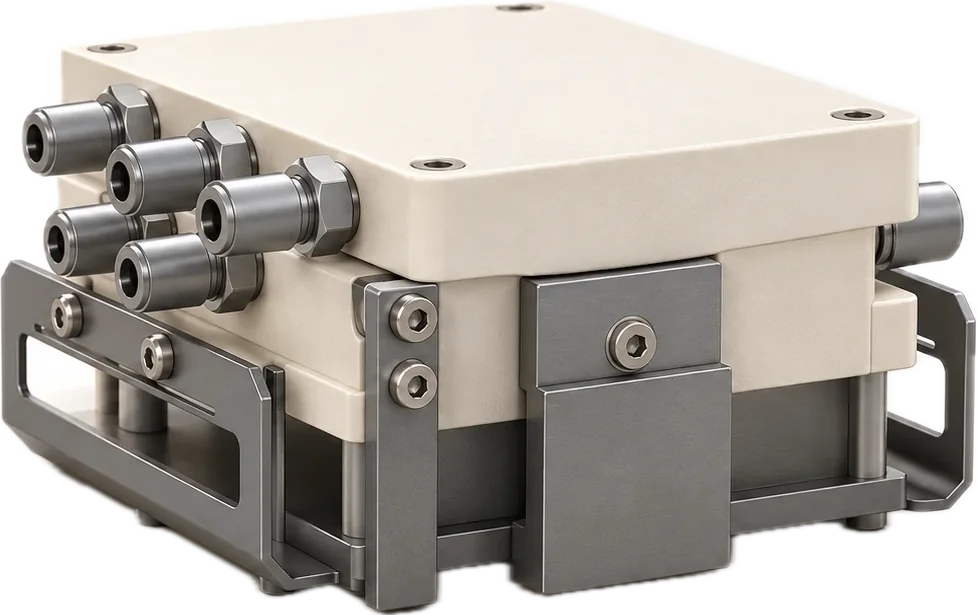
Illustrative render, internal features omitted
- First generation
- A compact, ceramic-isolated pulse heater with vacuum pick-up. It heats the die at the point of contact, and thermal isolation keeps the mechanics above it cool.
- Second generation
- Adds built-in active cooling for shorter cycles and separately controlled vacuum zones that release the die gradually, so thin dies stay flat. These are the zoned vacuum shown in the drawing and the basis of the progressive vacuum release concept.
- Interface
- Quick-change: the heater is replaced without dismantling the flexure assembly, so different heater assemblies can be fitted to the same module.
- Representation
- The drawing shows the heater in simplified exterior form, without internal details.
Configuration & host interface
Standard core, configured to the host tool.
01
Standard core
- Linear-motor axis on a flexure guideway
- Force sensor in the load path to the bond tool
- Force and position control on Axiom’s own servo drive
- Ceramic-isolated pulse heater with vacuum pick-up
02
Configurable parameters
- Pulse heater assembly, quick-change
- Active cooling and zoned vacuum release
03
Host interface, engineered to order
- Host bonder mounting pattern
- Integration with the host machine controller
- Fit and commissioning on the host bonder
Specifications
Force axis
| Bond force | 60 N (Design value) Maximum |
|---|---|
| Stroke | ±0.3 mm (Design value) On the flexure guideway |
| Guideway | Flexure, AISI 301 sheet Friction-free motion for smooth, repeatable force at the die |
| Guideway stiffness | 16.4 N/mm (Design value) |
| Flexure stress | 389 MPa (Design value) At the 1.2 mm stopper deflection, below yield and fatigue strength |
| Motor | Linear rod motor |
| Motor peak force | ≈ 45 N (Design value) 60 N bond force plus 4.9 N from the flexure, less 20 N of moving weight |
| Moving mass | 2 kg (Design value) |
| Linear encoder resolution | 50 nm (Design value) Selected encoder |
| Force sensor range | 0–200 N (Design value) Between the moving housing and the bond tool |
| Force sensor repeatability | ≤ ±0.1 % FS (Design value) Selected sensor |
Control
| Drive | Axiom’s own compact servo drive Mounted at the axis, about 30 × 35 × 25 mm |
|---|---|
| Control loops | Force and position Position on the linear encoder, bond force from the force sensor |
| Force measurement | Direct, at the bond tool Read where the force is applied |
| Algorithms | Axiom’s own force and position control Designed to find contact and build force without overshoot |
| Bond-force accuracy | ±0.5 % FS (Design value) Design target |
| Cycle time | 500 ms (Design value) Assumed in the design |
Pulse heater
| Maximum temperature | 300 °C (Design value) |
|---|---|
| Heating | At the point of contact Heats and cools again within one cycle |
| Isolation | Ceramic Keeps the force sensor, encoder and flexures above it cool |
| Die pick-up | Vacuum |
| Vacuum zones | 3 (Design value) Independently controlled, in the progressive release concept |
| Cooling | Built-in active cooling Second-generation heater, for shorter cycles |
| Heater change | Quick-change Without dismantling the flexure assembly |
Interfaces
| Host mounting | 5 × M5 · 2 × Ø3 mm (Design value) Threaded through holes and dowel holes of the existing bonder’s pattern |
|---|---|
| Machine controller | Host machine controller Drive, force sensor and encoder integrated by Axiom |
| Fit | Fitted to the host bonder Commissioning supported by Axiom |
- DESIGN
- Design value
Integration
The module is designed to drop into an existing bonder’s mounting pattern of five M5 threaded through holes and two Ø3 mm dowel holes, and heater assemblies can be swapped without dismantling the flexure assembly. It runs on Axiom’s own servo drive, with the position loop closed on the linear encoder and the bond force read from the force sensor. Axiom supplies the module, fits it to the host bonder, integrates its drive, force sensor and encoder with the machine controller and supports commissioning; the bonding process and its qualification run on the host platform.
What’s included
- Force-sensing bond head module: concept selection, detailed design, CAD models, drawings released for fabrication and a design report
- Flexure guideway sized by analytical model and checked by CAE for stiffness and stress
- Motion axis on Axiom’s own compact servo drive: linear rod motor, high-resolution linear encoder, force sensor in the load path
- Pulse heater across two generations: ceramic-isolated heater with vacuum pick-up, then active cooling and zoned vacuum, with design documentation and assembly planning for manufacture
- Progressive vacuum release concept: CAD model, flow and structural simulation of the pressure distribution, and technical documentation
- Fabrication and assembly of bond head hardware, and integration support into the host bonder: mechanical fit, electrical and control interfaces, commissioning
Validation
The detailed design is complete and released for fabrication; figures are design values, selected-component values and analysis results. It works to a lean specification: 60 N bond force, 300 °C heater temperature, ±0.3 mm stroke, a ±0.5 % FS bond-force accuracy target and an assumed 500 ms cycle time. The flexure’s analytical model and CAE agree and stay below yield and fatigue strength. Flow and structural simulation confirmed progressive vacuum release as feasible; hardware and bonding-process performance are validated separately.
System pairing
Powered by
The motor, force sensor and linear encoder close force and position loops on Axiom’s own compact servo drive, small enough to mount at the axis, so the module stays compact and the signals run short.
Motion Control · OEM equipment
Compact Single-Axis Servo Drive, Dual-Encoder Closed Loop
Axiom’s own single-axis servo drive, small enough to mount next to the axis inside compact equipment: a three-board stack with field-oriented control, dual-encoder inputs for full closed-loop control, and fieldbus interfaces configured to the application, EtherCAT and CANopen as standard.
- Footprint From the specification sheet
- 30 × 35 mm
- Bus voltage From the specification sheet
- 24 V
- Rated power From the specification sheet
- 200 W
Technologies
- Precision mechanical design
- Flexure guideways
- Linear motors and linear encoders
- Force sensing
- Force and position control algorithms
- Servo drive and control electronics
- Precision machining and assembly
- Structural and flow simulation (CAE)
- Equipment integration
Capabilities
- Every layer engineered by Axiom: mechanics, thermal and electrical design, precision machining, its own servo drive and its force and position control algorithms
- A force sensor in the load path to the bond tool, on a motion axis built around Axiom’s own servo drive, with the flexure guideway sized analytically and checked by CAE before release
- A module Axiom can build, fit to an existing bonder and integrate with its machine controller